
← VisaPredict AIResources
Real project downloads, a working glossary and IEEE references from the academic document.
Downloads
The project's real artifacts
Project reports, data and repositories, exactly as the pipeline publishes them. The reports and the panel regenerate with every new Visa Bulletin.
- Exploratory data analysis (EDA) reportPDF · Spanish · 446 KB ↓
- Exploratory data analysis (EDA) reportPDF · English · 443 KB ↓
- Feature-engineering reportPDF · Spanish · 275 KB ↓
- Feature-engineering reportPDF · English · 264 KB ↓
- Full historical Visa Bulletin panelCSV · 1.5 MB ↓
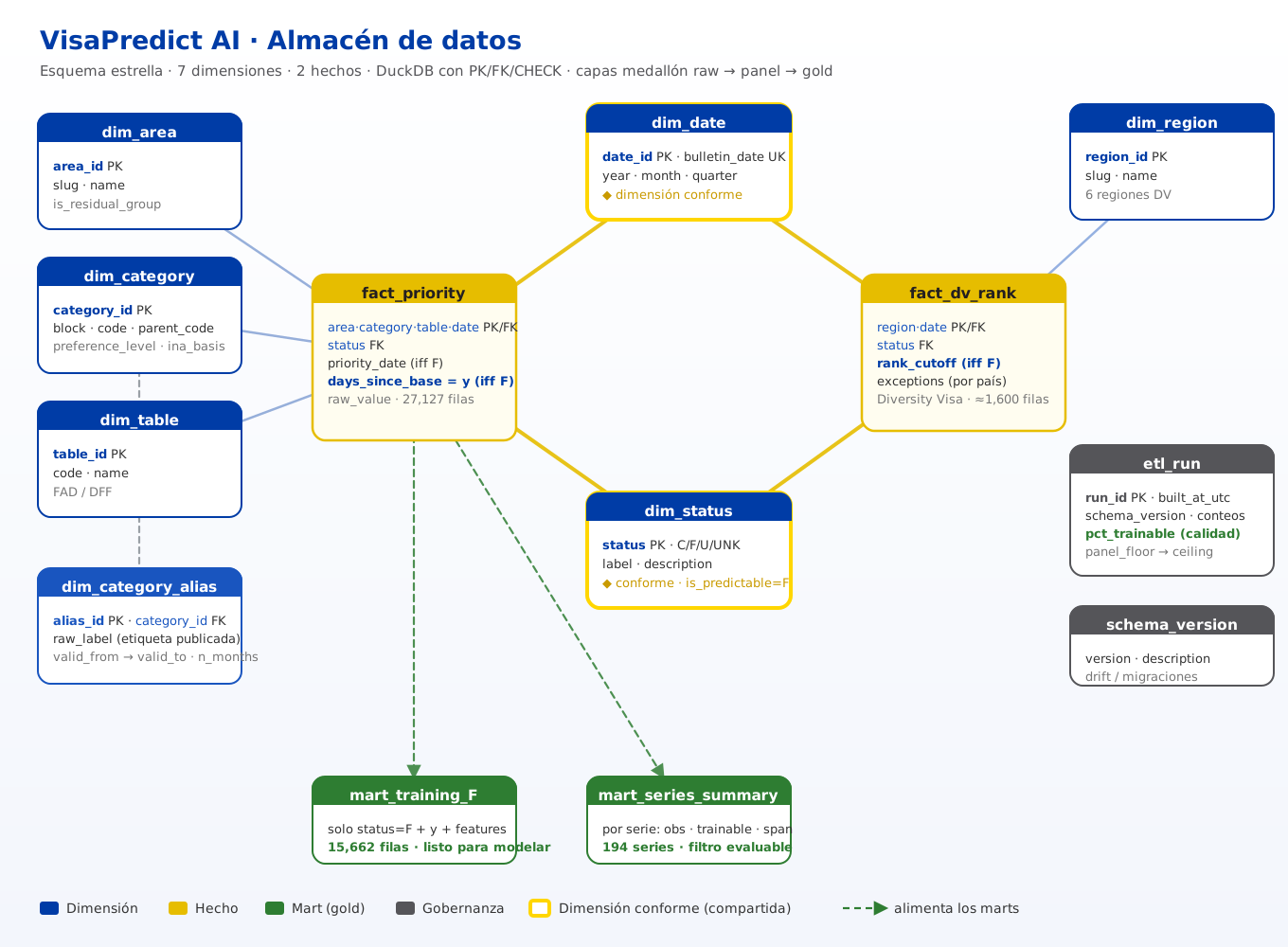
- Data-warehouse ER diagramSVG · 12 KB ↓
- Data & modeling repositoryGitHub ↗
- This site's repositoryGitHub ↗
Glossary
Operational vocabulary
Forty-two terms from the immigration domain and from statistical learning used throughout the proposal. Use the search box to filter by term or by a keyword within the definition.
ACFAutocorrelation Function
Function that quantifies the correlation between observations separated by different time lags; a central tool in the identification of ARIMA models.
AdamAdaptive Moment Estimation
Stochastic gradient optimization algorithm that combines momentum and per-parameter adaptive learning rates; the de facto standard in training deep networks.
AICAkaike Information Criterion
Model selection criterion that balances fit and parsimony: AIC = 2k − 2 ln(L).
ARIMAAutoregressive Integrated Moving Average
Family of statistical time-series models that combines autoregressive, differencing, and moving-average components to capture linear dynamics.
ARIMAX
Extension of ARIMA that incorporates exogenous regressor variables in addition to the endogenous dynamics of the target series.
Backlog (net)
In the immigration context, the accumulated volume of applications pending processing that exceeds the operational capacity of the system, measured by subtracting resolved applications from those received in a given period.
Chargeability area
Administrative category under which the Department of State counts an application for the purposes of the 7 % statutory limit. By default it coincides with the principal applicant's country of birth, not with their nationality or country of residence. The chargeability areas reported in the Visa Bulletin include individual countries (Mexico, India, China, the Philippines, etc.) and the aggregate category All Chargeability Areas Except Those Listed, which is NOT a country but a residual grouping.
All Chargeability Areas Except Those Listed
Aggregate category of the Visa Bulletin that brings together all chargeability areas not explicitly listed. It is an administrative grouping, not a single geographic entity; it includes dozens of countries of low to medium demand. Its composition varies over time as countries enter and leave the “effective limit” status by exceeding their quota, which constitutes a form of compositional non-stationarity. For this reason, this series will be reported in the pilot coverage but analyzed with explicit caution: any inference about trend will be accompanied by a warning about the change in composition.
Nationality vs. chargeability area
Non-equivalent terms in U.S. immigration law. Chargeability follows, by default, the country of birth (INA Section 202); the applicant's nationality may or may not coincide with their chargeability area. To avoid ambiguity, this document consistently uses country or area of chargeability when referring to the p dimension of the Visa Bulletin.
Batch Normalization
Regularization technique that standardizes the activations of a layer within each minibatch to stabilize and accelerate training.
BiLSTMBidirectional Long Short-Term Memory
Variant of LSTM that processes the sequence simultaneously in chronological and anti-chronological directions, allowing each hidden state to incorporate both past and future context.
DeepAR
Probabilistic architecture based on an autoregressive LSTM, designed to produce time-series forecasts with predictive distributions rather than point estimates.
Dates for Filing
Calendar published monthly by the Department of State that authorizes the early start of the adjustment-of-status process, generally with more recent dates than the Final Action Dates.
Diebold-Mariano (test)
Formal statistical test comparing the predictive accuracy of two models on the same series, under the null hypothesis of equal expected errors.
Dropout
Regularization technique that randomly deactivates a fraction of neurons during training, forcing representational redundancy and reducing overfitting.
EB-1 to EB-5
Employment-based preference categories for permanent residence in the U.S., ranging from priority workers with extraordinary abilities (EB-1) to investors (EB-5).
Early Stopping
Implicit regularization strategy that halts training when the error on the validation set stops improving for a predefined number of epochs.
F1, F2A, F2B, F3, F4
Family-based preference categories defined by the INA: unmarried adult children of citizens (F1), spouses and minor children of residents (F2A), unmarried adult children of residents (F2B), married children of citizens (F3), and siblings of citizens (F4).
Final Action Dates
Priority date published monthly in the Visa Bulletin that determines which applicants may receive the final adjudication of their permanent residence in that fiscal month.
Gradient Boosting
Family of ensemble methods that sequentially builds weak models, each focused on correcting the residual errors of the previous ensemble; XGBoost is its most widely used implementation.
INAImmigration and Nationality Act
U.S. federal law of 1965 that established the current system of quotas by category and country for permanent residence.
LSTMLong Short-Term Memory
Recurrent neural network architecture designed by Hochreiter and Schmidhuber in 1997 that incorporates memory cells and gates to capture long-term temporal dependencies and mitigate the vanishing gradient.
MAEMean Absolute Error
Mean absolute error: the average of the absolute values of the prediction errors.
MAPEMean Absolute Percentage Error
Mean absolute percentage error; sensitive to values close to zero and asymmetric between over- and under-estimations.
MASEMean Absolute Scaled Error
Mean absolute scaled error proposed by Hyndman and Koehler; a universal metric that normalizes the error by the error of the seasonal naïve.
Monte Carlo Dropout
Uncertainty quantification technique that applies dropout at inference time as well, interpreting the resulting predictions as samples from an approximate predictive distribution.
N-BEATSNeural Basis Expansion Analysis for Time Series
Deep architecture based purely on residual blocks that delivers interpretable forecasts without resorting to recurrent mechanisms.
PACFPartial Autocorrelation Function
Function that measures the correlation between the current observation and lagged observations while removing the linear influence of the intermediate lags.
PatchTST
Recent transformer architecture for long-series forecasting that segments the series into temporal patches treated as tokens, achieving competitive performance at a reduced computational cost.
Conformal predictionConformal Prediction
Non-parametric framework introduced by Vovk, Gammerman, and Shafer that produces prediction intervals with valid coverage guarantees under the minimal assumption of data exchangeability.
Priority Date
Priority dateOfficial registration date of an immigration petition, assigned when received by USCIS or by the Department of Labor; it functions as a place in the processing queue.
Prophet
Forecasting library developed by Meta AI that models time series as a sum of trend, seasonality, and holiday-effect components, robust to missing observations and outliers.
Per-country limit
Legal limit of 7 % of the annual preference visas available to nationals of a single country, the main source of the severe retrogression observed in high-demand countries such as Mexico, India, China, and the Philippines.
ReLURectified Linear Unit
Non-linear activation function f(x) = max(0, x); dominant in modern deep networks for its computational simplicity and its mitigation of the vanishing gradient.
Retrogression
Phenomenon of the U.S. immigration system in which the priority dates of the Visa Bulletin move backward instead of advancing, reflecting an early exhaustion of quotas or internal readjustments in the allocation of visas.
RMSERoot Mean Squared Error
Root mean squared error; a metric sensitive to large errors due to its quadratic penalization.
SARIMA
Seasonal extension of ARIMA that incorporates autoregressive, differencing, and moving-average components at the seasonal level with period s.
sMAPESymmetric Mean Absolute Percentage Error
Symmetric variant of MAPE that uses the average of the absolute observed and predicted values in the denominator.
TFTTemporal Fusion Transformer
Hybrid transformer-recurrent architecture for multi-horizon forecasting with heterogeneous inputs (past, known covariates, static variables).
Visa Bulletin
Monthly bulletin published by the Bureau of Consular Affairs of the U.S. Department of State that updates the priority dates for each immigration category and country.
Walk-forward Validation
Validation strategy for time series in which the training set expands progressively into the future, respecting temporal causality.
XGBoosteXtreme Gradient Boosting
Scalable and regularized implementation of gradient boosting over decision trees; a high-performance benchmark in machine learning competitions.
Bibliografía
Referencias IEEE
Sixty-four IEEE references in strict monotonic order of first appearance. Filter by thematic block to navigate the sources on the migration problem, the linear and deep models, the hybrids and modern architectures, the metrics and temporal validation, the applied resources, or the CRISP-DM methodology.
- [1]U.S. Citizenship and Immigration Services, “The Colorful History of the Green Card,” USCIS Stories from the Archives, Jan. 2023. [Online]. Available at: https://www.uscis.gov/about-us/our-history/stories-from-the-archives/the-colorful-history-of-the-green-card
- [2]CitizenPath, “History of the Green Card,” CitizenPath, Nov. 2023. [Online]. Available at: https://citizenpath.com/history-green-card/
- [3]A. Bao, “Trump says U.S. to `permanently pause migration from all Third World Countries' after DC shooting,” CNBC, Nov. 2025. [Online]. Available at: https://www.cnbc.com/2025/11/28/trump-us-to-permanently-pause-migration-from-all-third-world-countries.html
- [4]U.S. Citizenship and Immigration Services, “Quarterly All Forms, Net Backlog and Frontlog, Fiscal Year 2025, Quarter 3,” USCIS Immigration and Citizenship Data, 2025. [Online]. Available at: https://www.uscis.gov/tools/reports-and-studies/immigration-and-citizenship-data
- [5]Boundless Immigration, “USCIS Backlogs Hit Record High as EB-1A Growth Slows: Q2 FY2025 Data Analysis,” Sep. 2025. [Online]. Available at: https://www.boundless.com/blog/uscis-q2-fy2025-data
- [6]FWD.us, “Family-Based Immigration Backlogs: 5 Things to Know,” FWD.us Policy Report, 2022. [Online]. Available at: https://www.fwd.us/news/family-based-immigration-backlogs/
- [7]U.S. Department of State, Bureau of Consular Affairs, “Visa Bulletin for May 2026,” Washington, DC, USA, May 2026. [Online]. Available at: https://travel.state.gov/content/travel/en/legal/visa-law0/visa-bulletin/2026/visa-bulletin-for-may-2026.html
- [8]E. Fabio, “Time series analysis on U.S. immigration data,” master's thesis, Dept. of Mathematics and Statistics, San Diego State University, San Diego, CA, USA, 2022. [Online]. Available at: https://digitalcollections.sdsu.edu/do/d37e5cc6-0741-4312-b779-167574c09d57
- [9]T. Pu, C. Huang, J. Yang and M. Huang, “Transcending Time and Space: Survey Methods, Uncertainty, and Development in Human Migration Prediction,” Sustainability, vol. 15, no. 13, art. 10584, Jul. 2023, doi: 10.3390/su151310584.
- [10]U.S. Congress, “Immigration and Nationality Act of 1965 (Hart-Celler Act),” Pub. L. 89-236, 79 Stat. 911, Oct. 1965. [Online]. Available at: https://www.govinfo.gov/content/pkg/STATUTE-79/pdf/STATUTE-79-Pg911.pdf
- [11]S. Vegesana, “Predictive analytics for classification of immigration visa applications: a discriminative machine learning approach,” master's report, Dept. of Computer Science, Kansas State University, Manhattan, KS, USA, 2018. [Online]. Available at: https://krex.k-state.edu/items/895cd8b1-8b57-4ffa-9570-4427e97ed4a1
- [12]S. Jain, S. Agrawal, E. Mohapatra and K. Srinivasan, “A novel ensemble ARIMA-LSTM approach for evaluating COVID-19 cases and future outbreak preparedness,” Health Care Science, vol. 3, no. 6, pp. 409–425, Dec. 2024, doi: 10.1002/hcs2.123.
- [13]M. Carammia, S. M. Iacus and T. Wilkin, “Forecasting asylum-related migration flows with machine learning and data at scale,” Scientific Reports, vol. 12, no. 1, art. 1457, Jan. 2022, doi: 10.1038/s41598-022-05241-8.
- [14]U.S. Department of State, Bureau of Consular Affairs, “Immigrant Visa Statistics: Mexico Family Preference Final Action Dates from FY1992–2023,” 2024. [Online]. Available at: https://travel.state.gov/content/travel/en/legal/visa-law0/visa-statistics/immigrant-visa-statistics.html
- [15]M. Jordan, “Immigrants Are Becoming U.S. Citizens at Fastest Clip in Years,” The New York Times, Aug. 2024. [Online]. Available at: https://www.nytimes.com/2024/08/12/us/immigration-us-citizenship-rates.html
- [16]R. J. Hyndman and A. B. Koehler, “Another look at measures of forecast accuracy,” Int. J. Forecasting, vol. 22, no. 4, pp. 679–688, 2006, doi: 10.1016/j.ijforecast.2006.03.001.
- [17]C. Bergmeir and J. M. Benítez, “On the use of cross-validation for time series predictor evaluation,” Information Sciences, vol. 191, pp. 192–213, May 2012, doi: 10.1016/j.ins.2011.12.028.
- [18]F. X. Diebold and R. S. Mariano, “Comparing predictive accuracy,” Journal of Business & Economic Statistics, vol. 13, no. 3, pp. 253–263, 1995, doi: 10.1080/07350015.1995.10524599.
- [19]G. P. Zhang, “Time series forecasting using a hybrid ARIMA and neural network model,” Neurocomputing, vol. 50, pp. 159–175, 2003, doi: 10.1016/S0925-2312(01)00702-0.
- [20]C. B. A. Satrio, W. Darmawan, B. U. Nadia and N. Hanafiah, “Forecasting Indonesia exports using a hybrid model ARIMA-LSTM,” Procedia Computer Science, vol. 179, pp. 480–487, 2021, doi: 10.1016/j.procs.2021.01.031.
- [21]M. S. A. Mahmud and N. M. Noor, “Hybrid ARIMA-LSTM for COVID-19 forecasting: A comparative AI modeling study,” PeerJ Computer Science, vol. 11, art. e3195, 2025, doi: 10.7717/peerj-cs.3195.
- [22]D. Salinas, V. Flunkert, J. Gasthaus and T. Januschowski, “DeepAR: Probabilistic forecasting with autoregressive recurrent networks,” Int. J. Forecasting, vol. 36, no. 3, pp. 1181–1191, 2020, doi: 10.1016/j.ijforecast.2019.07.001.
- [23]S. Makridakis, E. Spiliotis and V. Assimakopoulos, “Statistical and machine learning forecasting methods: Concerns and ways forward,” PLoS ONE, vol. 13, no. 3, art. e0194889, 2018, doi: 10.1371/journal.pone.0194889.
- [24]G. E. P. Box and G. M. Jenkins, Time Series Analysis: Forecasting and Control, rev. ed. San Francisco, CA, USA: Holden-Day, 1976.
- [25]J. D. Hamilton, Time Series Analysis. Princeton, NJ, USA: Princeton Univ. Press, 1994.
- [26]R. J. Hyndman and G. Athanasopoulos, Forecasting: Principles and Practice, 3rd ed. Melbourne, Australia: OTexts, 2021. [Online]. Available at: https://otexts.com/fpp3/
- [27]D. A. Dickey and W. A. Fuller, “Distribution of the estimators for autoregressive time series with a unit root,” J. Amer. Statist. Assoc., vol. 74, no. 366a, pp. 427–431, 1979, doi: 10.1080/01621459.1979.10482531.
- [28]D. Kwiatkowski, P. C. B. Phillips, P. Schmidt and Y. Shin, “Testing the null hypothesis of stationarity against the alternative of a unit root,” J. Econometrics, vol. 54, no. 1–3, pp. 159–178, 1992, doi: 10.1016/0304-4076(92)90104-Y.
- [29]G. E. P. Box, G. M. Jenkins, G. C. Reinsel and G. M. Ljung, Time Series Analysis: Forecasting and Control, 5th ed. Hoboken, NJ, USA: John Wiley & Sons, 2015.
- [30]H. Akaike, “A new look at the statistical model identification,” IEEE Trans. Autom. Control, vol. 19, no. 6, pp. 716–723, Dec. 1974, doi: 10.1109/TAC.1974.1100705.
- [31]G. Schwarz, “Estimating the dimension of a model,” Ann. Statist., vol. 6, no. 2, pp. 461–464, Mar. 1978, doi: 10.1214/aos/1176344136.
- [32]S. J. Taylor and B. Letham, “Forecasting at scale,” The American Statistician, vol. 72, no. 1, pp. 37–45, 2018, doi: 10.1080/00031305.2017.1380080.
- [33]V. I. Kontopoulou, A. D. Panagopoulos, I. Kakkos and G. K. Matsopoulos, “A review of ARIMA vs. machine learning approaches for time series forecasting in data driven networks,” Future Internet, vol. 15, no. 8, art. 255, Jul. 2023, doi: 10.3390/fi15080255.
- [34]I. Goodfellow, Y. Bengio and A. Courville, Deep Learning. Cambridge, MA, USA: MIT Press, 2016. [Online]. Available at: http://www.deeplearningbook.org
- [35]Y. LeCun, Y. Bengio and G. Hinton, “Deep learning,” Nature, vol. 521, no. 7553, pp. 436–444, May 2015, doi: 10.1038/nature14539.
- [36]D. E. Rumelhart, G. E. Hinton and R. J. Williams, “Learning representations by back-propagating errors,” Nature, vol. 323, no. 6088, pp. 533–536, 1986, doi: 10.1038/323533a0.
- [37]Y. Bengio, P. Simard and P. Frasconi, “Learning long-term dependencies with gradient descent is difficult,” IEEE Trans. Neural Netw., vol. 5, no. 2, pp. 157–166, Mar. 1994, doi: 10.1109/72.279181.
- [38]D. P. Kingma and J. Ba, “Adam: A method for stochastic optimization,” in Proc. 3rd Int. Conf. Learning Representations (ICLR), San Diego, CA, USA, May 2015.
- [39]N. Srivastava, G. Hinton, A. Krizhevsky, I. Sutskever and R. Salakhutdinov, “Dropout: A simple way to prevent neural networks from overfitting,” Journal of Machine Learning Research, vol. 15, no. 56, pp. 1929–1958, 2014.
- [40]Y. Gal and Z. Ghahramani, “A theoretically grounded application of dropout in recurrent neural networks,” in Advances in Neural Information Processing Systems 29 (NIPS 2016), 2016.
- [41]S. Ioffe and C. Szegedy, “Batch normalization: Accelerating deep network training by reducing internal covariate shift,” in Proc. 32nd Int. Conf. Machine Learning (ICML), Lille, France, Jul. 2015, pp. 448–456.
- [42]J. L. Elman, “Finding structure in time,” Cognitive Science, vol. 14, no. 2, pp. 179–211, 1990, doi: 10.1207/s15516709cog1402_1.
- [43]S. Hochreiter and J. Schmidhuber, “Long short-term memory,” Neural Computation, vol. 9, no. 8, pp. 1735–1780, Nov. 1997, doi: 10.1162/neco.1997.9.8.1735.
- [44]M. Schuster and K. K. Paliwal, “Bidirectional recurrent neural networks,” IEEE Trans. Signal Process., vol. 45, no. 11, pp. 2673–2681, Nov. 1997, doi: 10.1109/78.650093.
- [45]A. Graves and J. Schmidhuber, “Framewise phoneme classification with bidirectional LSTM and other neural network architectures,” Neural Netw., vol. 18, no. 5–6, pp. 602–610, 2005, doi: 10.1016/j.neunet.2005.06.042.
- [46]B. Lindemann, T. Müller, H. Vietz, N. Jazdi and M. Weyrich, “A survey on long short-term memory networks for time series prediction,” Procedia CIRP, vol. 99, pp. 650–655, 2021, doi: 10.1016/j.procir.2021.03.088.
- [47]K. Cho, B. van Merriënboer, C. Gulcehre, D. Bahdanau, F. Bougares, H. Schwenk and Y. Bengio, “Learning phrase representations using RNN encoder-decoder for statistical machine translation,” in Proc. 2014 Conf. Empirical Methods Natural Language Processing (EMNLP), Doha, Qatar, Oct. 2014, pp. 1724–1734, doi: 10.3115/v1/D14-1179.
- [48]B. Lim and S. Zohren, “Time-series forecasting with deep learning: A survey,” Phil. Trans. R. Soc. A, vol. 379, no. 2194, art. 20200209, 2021, doi: 10.1098/rsta.2020.0209.
- [49]S. Smyl, “A hybrid method of exponential smoothing and recurrent neural networks for time series forecasting,” Int. J. Forecasting, vol. 36, no. 1, pp. 75–85, 2020, doi: 10.1016/j.ijforecast.2019.03.017.
- [50]S. Makridakis, E. Spiliotis and V. Assimakopoulos, “The M4 Competition: 100,000 time series and 61 forecasting methods,” Int. J. Forecasting, vol. 36, no. 1, pp. 54–74, 2020, doi: 10.1016/j.ijforecast.2019.04.014.
- [51]S. Hamiane, Y. Ghanou, H. Khalifi and M. Telmem, “Comparative analysis of LSTM, ARIMA, and hybrid models for forecasting future GDP,” Ingénierie des Systèmes d'Information, vol. 29, no. 3, pp. 1061–1072, 2024, doi: 10.18280/isi.290306.
- [52]A. Agbessi Pierre, A. A. Salami, K. S. Agbosse and B. Birregah, “Peak electrical energy consumption prediction by ARIMA, LSTM, GRU, ARIMA-LSTM and ARIMA-GRU approaches,” Energies, vol. 16, no. 12, art. 4739, 2023, doi: 10.3390/en16124739.
- [53]B. N. Oreshkin, D. Carpov, N. Chapados and Y. Bengio, “N-BEATS: Neural basis expansion analysis for interpretable time series forecasting,” in Proc. 8th Int. Conf. Learning Representations (ICLR), Apr. 2020.
- [54]B. Lim, S. Ö. Arık, N. Loeff and T. Pfister, “Temporal Fusion Transformers for interpretable multi-horizon time series forecasting,” Int. J. Forecasting, vol. 37, no. 4, pp. 1748–1764, 2021, doi: 10.1016/j.ijforecast.2021.03.012.
- [55]Y. Nie, N. H. Nguyen, P. Sinthong and J. Kalagnanam, “A time series is worth 64 words: Long-term forecasting with transformers,” in Proc. 11th Int. Conf. Learning Representations (ICLR), May 2023.
- [56]T. Chen and C. Guestrin, “XGBoost: A scalable tree boosting system,” in Proc. 22nd ACM SIGKDD Int. Conf. Knowledge Discovery and Data Mining (KDD), San Francisco, CA, USA, Aug. 2016, pp. 785–794, doi: 10.1145/2939672.2939785.
- [57]K. Hoffmann Pham and M. Luengo-Oroz, “Predictive modelling of movements of refugees and internally displaced people: Towards a computational framework,” J. Ethnic and Migration Studies, vol. 49, no. 2, pp. 408–444, 2023, doi: 10.1080/1369183X.2022.2100546.
- [58]L. J. Tashman, “Out-of-sample tests of forecasting accuracy: An analysis and review,” Int. J. Forecasting, vol. 16, no. 4, pp. 437–450, 2000, doi: 10.1016/S0169-2070(00)00065-0.
- [59]V. Vovk, A. Gammerman and G. Shafer, Algorithmic Learning in a Random World. Nueva York, NY, USA: Springer, 2005, doi: 10.1007/b106715.
- [60]D. J. Bier, “Immigration wait times from quotas have doubled: Green card backlogs are long, growing, and inequitable,” Cato Institute Policy Analysis No. 873, Jun. 2019. [Online]. Available at: https://www.cato.org/publications/policy-analysis/immigration-wait-times-quotas-have-doubled
- [61]F. Chollet, Deep Learning with Python, 2nd ed. Shelter Island, NY, USA: Manning Publications, 2021.
- [62]F. Pedregosa et al., “Scikit-learn: Machine learning in Python,” Journal of Machine Learning Research, vol. 12, pp. 2825–2830, 2011.
- [63]A. Paszke et al., “PyTorch: An imperative style, high-performance deep learning library,” in Advances in Neural Information Processing Systems 32 (NeurIPS 2019), 2019, pp. 8026–8037.
- [64]P. Chapman, J. Clinton, R. Kerber, T. Khabaza, T. Reinartz, C. Shearer, and R. Wirth, CRISP-DM 1.0: Step-by-step Data Mining Guide. Chicago, IL, USA: SPSS Inc. / The CRISP-DM Consortium, 2000.