
Predicting priority dates in the U.S. Visa Bulletin
Applied forecasting system for the multi-series panel indexed by country or chargeability area × immigration category × table type × month. Forecasts at 1-, 3-, 6- and 12-month horizons with 95% prediction intervals, under the CRISP-DM methodology and expanding walk-forward validation — with no architecture privileged in advance.
- Monthly bulletins
- 298
- Panel observations
- 27,911
- Country × category × table series
- 194
- Pilot countries / areas
- 5
- Named methodology
- CRISP-DM
The problem, in one figure
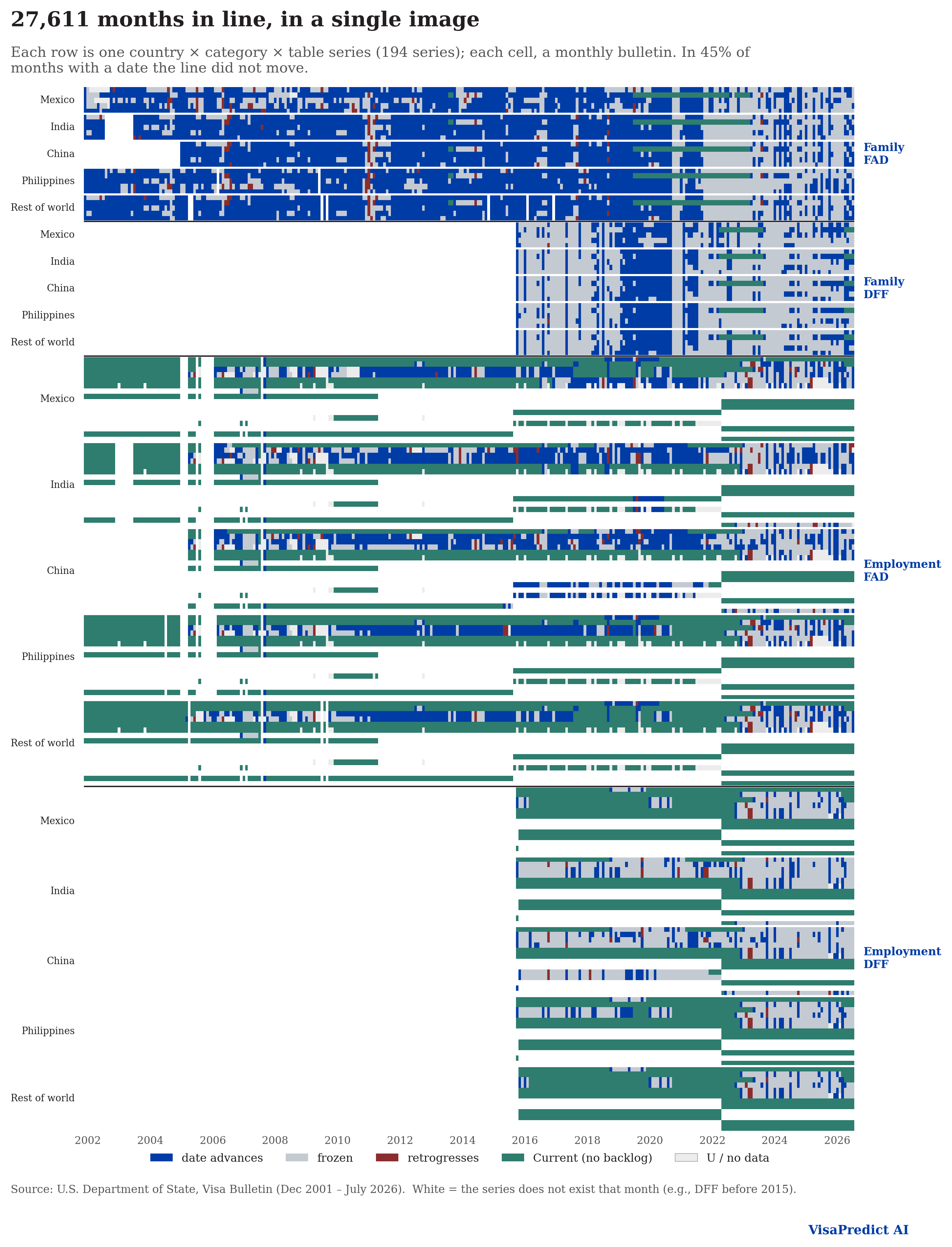
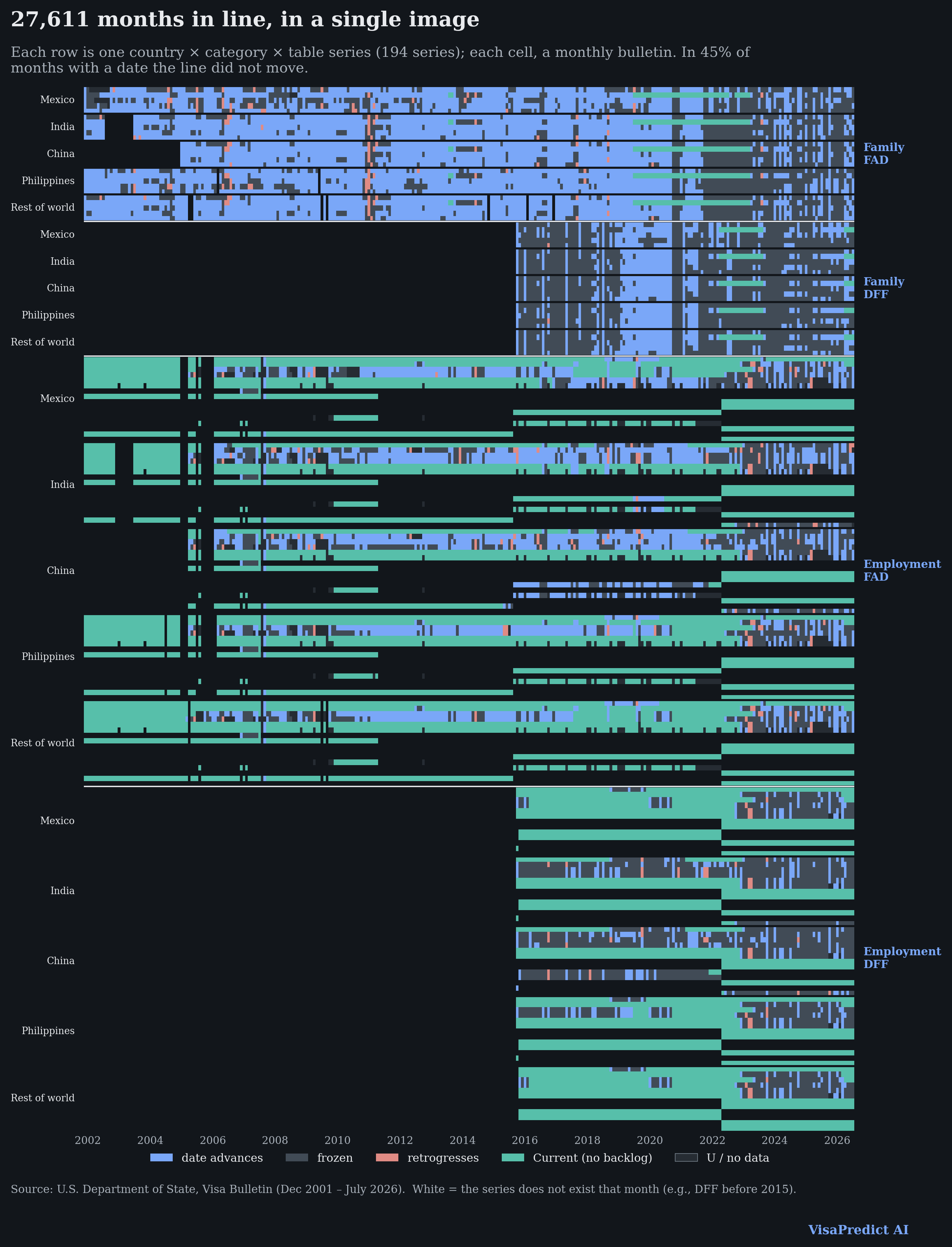
Each row is one country × category × table series and each column one of the 298 monthly bulletins published since December 2001: the line advances, freezes, and sometimes retrogresses years in a single bulletin. Anticipating that movement — with its uncertainty — is the problem this system takes on.
When is my date?
Pick your country or area, category and table and see the deployed model's 12-month forecast, with 80% / 95% prediction bands.
See your category's forecastThe evidence, against reality
Every forecast uses only information available at its origin and is graded against the real published bulletin (a leakage-free backfill).
See the prospective scorecardExplore the project
The project is split for focused reading: the academic document, the data engineering, the interactive historical data, the reference resources and the assistant.
Proposal
The academic document: introduction, theoretical framework, product, CRISP-DM methodology, tables and reproducibility.
I · Introduction, II · Framework, III · Product & validation, IV · CRISP-DM methodology, Tables & figures, Reproducibility02Data engineering
How the panel was built and understood: pipeline, exploratory analysis, feature engineering, MLOps practices, repository structure and a star-schema warehouse.
Building the panel, Exploratory analysis, Feature engineering, MLOps practices, Repo structure, Data model03Historical data
The empirical heart: a live bulletin, per-category forecasts, an interactive explorer over the real panel and the system's prospective scorecard.
Live bulletins, Forecast, Historical explorer, Prospective scorecard04Forecast gallery
Every country × category × table forecast series in a filterable gallery: skim by country or by category and open any one for the full fan chart with its 80% and 95% bands.
Featured, By country, By category05Resources
Real project downloads, a working glossary and IEEE references from the academic document.
Downloads, Glossary, IEEE references06Plan and progress
Verifiable MLOps plan status: progress, epics, user stories, execution route and recent evidence.
Dashboard, Route, Epics, Story plan, Progress log07Assistant
VisaBot: a retrieval-augmented (RAG) conversational assistant over the whole project documentation, with cited answers.
VisaBotSynthetic overview of the project
The project will develop an applied predictive system for Visa Bulletin priority dates, organized as a multiseries panel indexed by chargeability country, immigrant category, and table type, under the CRISP-DM methodology (Chapman et al. 2000). Linear and nonlinear models will be compared empirically without privileging architectures in advance.
Transparent forecasting of the Visa Bulletin
The U.S. Department of State's monthly bulletin publishes priority dates by chargeability country and immigrant category. More than three decades of public data (1992–2026) without open, systematically evaluated predictive models that report 95 % prediction intervals. Nearly 4 million people are awaiting a family-based visa [6], within a global USCIS backlog of 11.5 million cases across all forms [4].
Multiseries panel yp,c,b,t
Each cell combines a chargeability country or area p, an immigrant category c, a table type b (FAD or DFF), and a calendar month t. The predicted variable is continuous: days since a base date. The system is trained exclusively on observations with a specific date; Current and Unavailable cells are kept as descriptive annotation.
Comparative framework under CRISP-DM
Three complementary families: linear (seasonal naïve, ARIMA, SARIMA, Prophet), local nonlinear (pure LSTM, ARIMA-LSTM), and global/tabular (DeepAR, XGBoost). Expanding walk-forward validation with scaled metrics (sMAPE, MASE, MAE, RMSE) and 95 % prediction intervals via three mechanisms (analytical ARIMA, MC dropout, conformal prediction).
Dataset, system, and application
(1) A reproducible longitudinal database of the Visa Bulletin 1992–2026 published under an open license; (2) a reproducible predictive system with code and version manifests; (3) an academic demonstration application with explicit warnings about the informational and non-legal nature of the estimates.
About the author and the advisor
Thesis student and thesis director of the MIAAD project, Autonomous University of Ciudad Juárez. The host course "Anteproyecto de Innovación Tecnológica" is coordinated by Dr. Gilberto Rivera Zárate.


Anteproyecto de Innovación Tecnológica · Master's in Artificial Intelligence and Data Analytics · UACJ · January–May 2026 term · Coordination: Dr. Gilberto Rivera Zárate.
Interested in the project?
Academic inquiries, collaboration, or bibliographic exchange.